

Note: Results vary by individual preparation, starting position, and subject combination. This guide provides a strategic framework — the outcomes will depend on consistency, effort, and how well the approach is applied to your specific circumstances.
With 12 weeks remaining until prepare for IB exams, strategic revision can meaningfully improve your position across all six subjects. This intensive revision guide provides a structured 12-week plan prioritising high-impact study techniques, paper-specific strategies, and time-efficient practice methods. Whether you are working toward the minimum Diploma threshold or aiming for competitive scores for university applications, this crash course framework helps you use your remaining time as effectively as possible.
Get in touch for IB exams preparation with our IB Innovators expert tutors!
Assess Your Current Position – Where Are You Now?
Begin Week 12 with an honest academic audit. This assessment determines your revision priorities and time allocation across subjects.
Essential steps:
- List current predicted grades for all six subjects
- Identify subjects below target grades
- Calculate points needed for the IB Diploma (24 minimum) or university offers
- Confirm Internal Assessment, Extended Essay, and Theory of Knowledge completion status
- Note any retake subjects from the November session
Calculate your exact point gap. If you are predicted 32 points whilst targeting 38 for a university offer, you need six additional points. The IB Diploma requires a minimum of 24 points across six subjects with no grade 1 and a maximum of three grade 3s. Understanding this gap tells you which subjects deserve intensive focus and which need only maintenance revision.
University requirements vary significantly by institution and course. It is worth confirming the specific requirements of your target universities directly — many courses specify both total points and individual HL subject grades. Use your school’s university guidance resources or contact admissions offices directly for accurate information.
Your 12-Week Timeline Prepare for IB Exams
Structure your three months into four distinct phases with specific focuses and deliverables.
 Foundation Phase (Weeks 12–10)
Focus on content review and knowledge gap identification. Review syllabus content, create topic summaries, and identify weak areas. Allocate 15–20 hours weekly across six subjects. Complete notes for all topics and establish clear priority areas by Week 10.
Practice Phase (Weeks 9–7)
Shift to past paper practice and technique development. Complete timed past papers for Papers 1, 2, and 3. Analyse official mark schemes thoroughly. Practise applying command terms correctly in responses. Increase study time to 20–25 hours weekly. Complete two to three past papers per subject and identify common mistake patterns.
Refinement Phase (Weeks 6–4)
Focus on targeted improvement using examiner insights. Address weak topics identified during practice. Consider examiner-led revision for challenging subjects. Complete mock exams under timed conditions. Allocate 25–30 hours weekly with intensive subject focus. Improved mock exam scores and mastered difficult topics demonstrate progress during this phase.
Final Preparation (Weeks 3–1)
Consolidate learning and refine exam techniques. Complete final past papers focusing on time management. Review formula sheets and key concept summaries. Implement stress management strategies. Dedicate 30+ hours weekly to targeted practice. Confident exam readiness and refined time management signal preparation completion.
Prioritise Subjects Strategically – Maximise Point Gains
Not all subjects require equal revision time. Strategic allocation focuses your effort where it is most likely to move your grade.
Priority Tier 1 (40% of study time)
Subjects one to two grades below target offer the most realistic improvement opportunities within 12 weeks. Higher Level subjects carry more weight for university requirements. Focus on achievable grade improvements — moving from HL 4 to HL 5 is a more realistic target than moving from SL 3 to SL 7 within this timeframe.
Priority Tier 2 (35% of study time)
Standard Level subjects near target grades require consistent practice to hold their position. Subjects required for your university courses need attention regardless of predicted grades. Complete any unfinished core components including Theory of Knowledge essays or Extended Essay drafts.
Priority Tier 3 (25% of study time)
Subjects at or above target grade need maintenance revision only. Language B subjects with strong predicted grades require minimal additional time investment. This allocation prevents grade slippage whilst freeing capacity for your priority subjects.
Practical example: Improving HL Biology from a predicted 5 to a 6 gains one point. Improving SL Economics from a 4 to a 5 also gains one point. Allocate the majority of your revision time to subjects where grade improvement is both achievable and most valuable to your overall score and university requirements.
For targeted support in priority subjects, personalised IB tutoring from certified examiners can provide structured gap analysis and mark scheme insight for the specific topics where you are losing marks.
High-Impact Revision Methods for Maximum Efficiency
Evidence-based study techniques optimised for time pressure deliver stronger results than passive content review.
Active Recall with Spaced Repetition
Retrieve information from memory without notes. Review at increasing intervals — daily initially, then every three days, then weekly. Create flashcards for key concepts across all subjects. Cognitive psychology research consistently demonstrates that active recall produces substantially stronger long-term retention compared to passive re-reading. Dedicating focused daily sessions per subject in this way is more effective than long passive reading sessions.
Past Paper Analysis — Not Just Practice
Complete past papers under timed conditions. Mark using official IB mark schemes. Identify specific question types causing mark loss. Practise similar question patterns repeatedly. Review examiner reports highlighting common mistakes. Quality surpasses quantity — deeply analysing three papers is more valuable than rushing through ten. Students who engage carefully with mark scheme requirements before retaking similar questions develop noticeably stronger accuracy over time.
Command Term Mastery
Master critical command terms including discuss, evaluate, analyse, compare, explain, and describe. Create response frameworks for each term. ‘Discuss’ requires a definition, multiple perspectives, evidence, evaluation, and a conclusion. ‘Evaluate’ demands judgement supported by criteria and evidence. Practise writing responses using correct command term structures consistently. This precision directly impacts mark allocation across all subjects.
Topic Clustering for Memory Consolidation
Group related concepts across subjects. Link HL Biology cellular respiration with HL Chemistry thermodynamics and HL Physics energy conservation. These connections strengthen semantic memory networks and improve recall speed during exams. Interdisciplinary understanding demonstrates deeper comprehension valued by IB examiners.
Master Each Paper Type – Targeted Exam Techniques
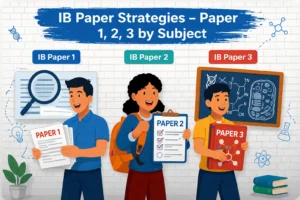
Paper 1 Strategies (Multiple Choice / Objective Questions)
Allocate approximately one minute per mark as a general guide — adjust based on question difficulty and your confidence in the topic. Eliminate obviously incorrect answers first. Circle key words in the question such as ‘always,’ ‘never,’ and ‘most likely.’ Skip difficult questions initially and return with remaining time. Do not leave blank answers — make an educated guess from your remaining options in the final minutes.
Paper 2 Strategies (Short Answer / Extended Response)
Read all questions before starting. Allocate time roughly in proportion to marks available — higher-mark questions need more time than lower-mark ones. Use command terms to structure your answers appropriately. Include diagrams where relevant, particularly in Sciences. Reference mark scheme language in responses to align with examiner expectations.
Paper 3 Strategies (HL Only – Subject-Specific)
Strategies vary by subject. Sciences require data analysis and experimental evaluation. Business Management and Economics emphasise case study application with multi-perspective evaluation. Practise subject-specific Paper 3 formats extensively and understand what examiners are looking for at HL level. Manage time carefully for longer, more complex questions.
Structured revision courses can support students in the mid-preparation phase with guided Paper 1, 2, and 3 practice across the main IBDP subjects.
Sample Weekly Revision Schedule – 25–30 Hours
Structure your week balancing intensive revision with necessary rest periods.
| Day / Period | Activity |
| Mon–Fri Mornings | 2 hours before school: Active recall flashcard review |
| Mon–Fri Afternoons | 3–4 hours after school: Subject rotation focusing on Priority Tier 1 subjects |
| Mon–Fri Evenings | 1 hour: Past paper questions and mistake review |
| Saturday Morning | 4 hours: Complete full past papers for 1–2 subjects under timed conditions |
| Saturday Afternoon | 3 hours: Mark papers thoroughly, analyse errors, review mark schemes |
| Saturday Evening | 1 hour: Consolidate the week’s learning |
| Sunday Morning | 3 hours: Priority Tier 2 subject revision |
| Sunday Afternoon | 2 hours: Create next week’s study plan and update progress tracker |
| Sunday Evening | Rest and recovery |
Total weekly commitment: approximately 30–35 hours across weekdays (20–25 hours) and weekends (10 hours). Adjust for school commitments and CAS activities. Increase hours during holiday periods including Easter break and study leave. If you are experiencing burnout symptoms, reduce slightly whilst maintaining a minimum structured daily session — sustainable revision over 12 weeks is more effective than short periods of excessive hours followed by collapse.
Accelerate Progress with Expert IB Tutoring
Expert guidance can meaningfully improve how efficiently you use your remaining 12 weeks — particularly for students with specific knowledge gaps or technique weaknesses.
Scenarios where professional support is most valuable:
- Predicted grades two or more levels below target, indicating significant knowledge gaps
- Complex topics — such as HL Mathematics proofs, Physics derivations, or Chemistry mechanisms — that are not resolving through independent study
- Consistent mark loss on specific question types despite repeated practice
- Difficulty identifying exactly what the mark scheme is looking for in extended responses
IB Innovators provides 1-on-1 tutoring with certified IB examiners through flexible hour packages, as well as small-group Rapid Revision Courses covering Biology, Business Management, Chemistry, Economics, ESS, Math AA, Math AI, and Physics at HL and SL. Both options are designed to fit within the 12-week preparation window for May or November examination sessions.
Maintain Wellbeing During Intensive Revision
Sustainable revision schedules consistently outperform exhausted extended hours. Prioritise 7–8 hours of sleep nightly — adequate sleep is well established as essential for memory consolidation and cognitive performance. Implement 10-minute breaks every 50 minutes using the Pomodoro Technique. Maintain 30 minutes of daily physical activity to reduce exam anxiety and support focus. Support energy and concentration through balanced meals, including complex carbohydrates and adequate hydration.
Recognise burnout warning signs: constant fatigue, motivation loss, and physical symptoms such as headaches. Communicate openly with teachers, parents, and school counsellors. Intensive revision does not require sacrificing your health — a structured 25–30 hour weekly schedule with proper rest is more effective than exhausted 40+ hour weeks with declining retention and focus.
Your 3-Month IB Exam Success Starts Now
Strategic prioritisation, time-efficient techniques, and — where needed — expert support give you a strong foundation for your May or November examinations. Three months is a meaningful window when used well. Begin your assessment audit today: identify your exact point gaps, rank your priority subjects, and build a weekly schedule you can sustain.
IB Innovators’ certified examiners are available to support you through this final phase — whether through intensive 1-on-1 sessions, group revision courses, or a free consultation to build your personalised 12-week strategy.
→ Book your free 30-minute consultation with IB Innovators to create your personalised crash revision strategy and make the most of your remaining preparation time.