

Grade boundaries vary each session — always verify current boundaries with your IB coordinator or the official IBO website.
Achieving a Level 7 in IB subjects requires performance in the highest mark band across combined assessments — Papers 1 through 3 and the Internal Assessment. This grade demonstrates exceptional understanding, consistent performance across all components, and a high-quality Internal Assessment. Only a small proportion of students globally reach Level 7 in core subjects including Biology, Chemistry, and Mathematics each session.
What Does a Level 7 in IB Actually Require?
Level 7 in IB typically requires performance in the highest mark band across all assessment components. Grade boundaries vary by subject and examination session, so students should always check the most recent published boundaries for their specific subject and level. What is consistent across subjects is the expectation of depth, precision, and completeness in every assessment component.
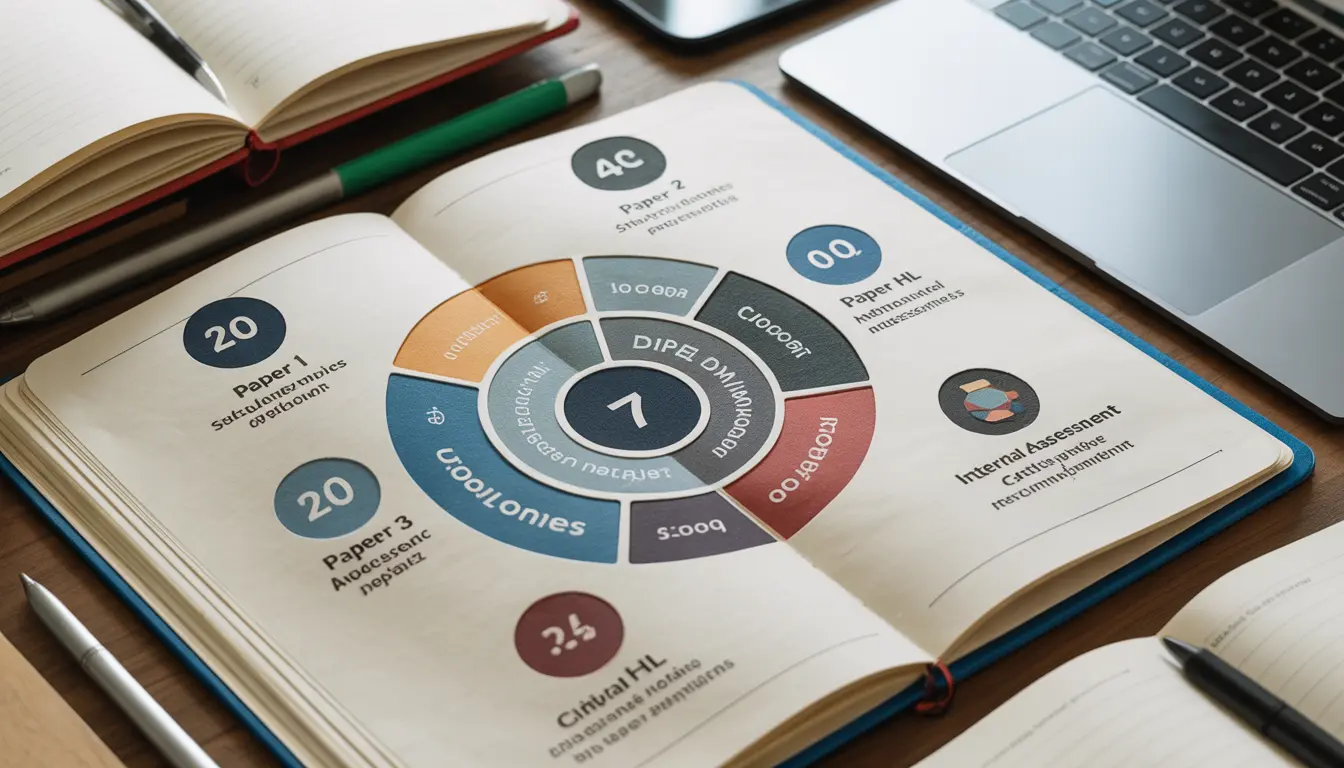
Component breakdown across most DP subjects:
- Paper 1 contributes 20% of the final grade (multiple choice or short-answer questions)
- Paper 2 contributes 40% of the final grade (structured response questions)
- Paper 3 contributes 20% for HL students (data analysis and extended response)
- Internal Assessment contributes 20% (critical for Level 7 achievement across all subjects)
Reaching Level 7 in IB demands strong performance across every component — you cannot compensate for a weak paper with an exceptional one. The Internal Assessment in particular carries significant weight and must be approached with the same rigour as the written papers.
What IB Examiners Look for in Level 7 Answers
IB examiners award marks in the highest band based on specific criteria including depth of understanding, precise terminology, and complete explanations with justifications.
Depth Over Breadth
Level 7 answers provide detailed mechanisms, not surface descriptions. For Biology cellular respiration, explain the electron transport chain with reference to the relevant protein complexes, not simply ‘produces ATP’. Examiners look for several well-developed points per question, not a wide list of undeveloped observations.
Command Term Mastery
‘Discuss’ requires arguments both for and against, developed across multiple points. ‘Evaluate’ requires a judgement supported by evidence and clear criteria. ‘Explain’ requires cause-and-effect relationships with detailed mechanisms, not simple description. Students who consistently interpret and respond to command terms correctly place themselves firmly in the higher mark bands.
Precise Scientific Terminology
Use exact terms: ‘glycolysis’ rather than ‘sugar breakdown’. Specify ‘substrate-level phosphorylation’ rather than ‘ATP production’. Level 7 answers demonstrate consistent, accurate use of subject-specific vocabulary throughout — examiners reward precision and penalise vague or approximate language.
Complete Explanations
Every statement should be supported by evidence. Where data is available — from experimental results, stimulus material, or well-known examples — reference it explicitly. Cite graphs, label diagrams accurately, and link observations to underlying principles rather than stating conclusions without justification.
Diagram Excellence
Fully labelled diagrams should include all relevant components expected by the mark scheme, with annotations that explain function rather than simply identify structures. In Biology IAs in particular, diagrams are expected to reflect experimental rigour — include all components relevant to your methodology and ensure every label adds meaning.
Subject-Specific Strategies for Level 7 Achievement
Level 7 in IB strategies vary by subject group based on assessment structure and examiner expectations for each discipline.
Sciences (Biology, Chemistry, Physics HL/SL)
IA Excellence (20% of grade)
Research question specificity is essential. A well-formed question such as ‘Effect of temperature across a defined range on enzyme catalase activity measured by oxygen production rate’ is far stronger than a generic framing like ‘How temperature affects enzymes’. Examiners reward clarity, measurability, and scientific precision in the research question itself.
Data collection should include sufficient trials and data points to allow meaningful statistical analysis. Standard deviation and percentage uncertainty calculations are expected at the highest mark band. Evaluation must go beyond identifying limitations — discuss their likely impact on results and suggest realistic improvements.
Paper Strategy
Manage time carefully across all papers. Allocate your time proportionally to the marks available for each question, spending slightly more time on higher-mark extended response questions. In Paper 3, graph and data descriptions should identify key trends with specific reference to the data provided — general statements without data support are unlikely to reach the top mark band.
Students needing additional support in Biology, Chemistry, or Physics can explore subject-specific examiner-led guidance.
Mathematics (AA & AI HL/SL)
Exploration (IA) Scoring
Level 7 in IB explorations demonstrate sophisticated mathematical understanding. This typically involves proofs, derivations, or extensions that go beyond standard syllabus content. The strongest explorations apply mathematical reasoning to a well-defined real-world context — such as modelling physical or economic phenomena using calculus — and reflect genuine personal engagement with the topic. A clearly articulated aim and logical structure throughout are essential for reaching the highest criterion descriptors.
Exam Technique
Allocate your time proportionally to marks available across each paper. Show all working clearly — partial credit applies in mathematics even where the final answer is incorrect, and examiners cannot award method marks for unsupported answers. Use your calculator to store intermediate values and avoid rounding errors in multi-step problems. In Paper 3 HL proofs, ensure each step follows logically from the previous one, using appropriate connecting language to signal the progression of your argument.
Students can explore subject-specific Mathematics support for both Analysis and Approaches and Applications and Interpretation at HL and SL.
Humanities (Economics, Business Management, Psychology)
Extended Response Excellence
Extended response questions require well-structured, analytical answers that go beyond description. A strong structure moves from definition of key terms through application of relevant theory to evaluation of limitations, alternative perspectives, and contextual factors. Real-world examples should be specific and current — general or vague references to ‘a company’ or ‘a country’ rarely reach the highest mark band. Include data, named organisations, and dates where relevant to ground your argument in concrete evidence.
Additional subject-specific support is available for Economics, Business Management, and Psychology.
Study Habits That Support Level 7 Achievement
Students who reach Level 7 in IB consistently invest substantial time beyond classroom contact hours in HL subjects, with SL subjects receiving proportionally less but still structured weekly revision. The quality of that study time — through active retrieval rather than passive review — matters as much as the quantity.
Active Recall Strategies
Practise past papers under timed conditions across all subjects. Students who complete a meaningful volume of past papers before exams — working through them systematically with mark scheme analysis — develop significantly stronger exam readiness than those who rely on content review alone. Use flashcard systems for subject-specific terminology, structured by topic, and test yourself daily in short focused sessions rather than long infrequent reviews.
Spaced Repetition Schedule
Review new content at increasing intervals — for example, the day after learning it, three days later, then one week, two weeks, and one month later. Students who revisit each topic multiple times through spaced repetition develop far more durable recall than those who review content once before the exam. Begin spaced revision 4–6 months before exams, not in the final weeks.
Mark Scheme Analysis
Annotate past papers with the relevant mark scheme immediately after completing them under timed conditions. Identify which command terms appear most frequently in your subject, what depth of response is expected for each, and where your answers consistently fall short. This process builds an intuitive understanding of examiner expectations that is difficult to develop through content study alone.
5 Mistakes That Prevent Level 7 Achievement
- Insufficient IA Quality — The Internal Assessment carries significant weight in the final grade and is one of the most common areas where students fall short of Level 7. Invest adequate time in research design, data collection, and multiple draft revisions. Examiner-led IA and EE guidance provides targeted feedback at each stage of the process.
- Weak Paper 3 Performance — Data analysis papers require quantitative, specific observations. State precise changes with reference to the data provided: for example, ‘pH increased from 6.2 to 9.0 across the temperature range tested’ rather than ‘pH increased significantly’. Examiners cannot award marks for vague trend descriptions.
- Incomplete Command Term Responses — ‘Explain’ requires cause-and-effect, not description. ‘Evaluate’ requires a supported judgement, not a list of points. Identify the command terms in every question before you begin writing and structure your answer to meet those specific expectations.
- Time Mismanagement in Exams — Spending disproportionate time on a lower-mark question leaves insufficient time for higher-mark questions. Allocate time in proportion to marks available and move on if you are not progressing. An incomplete answer to a 15-mark question costs more than a slightly underdeveloped 10-mark response.
- Neglecting Specification Detail — Generic examples score in mid-level mark bands. Level 7 in IB responses use specific, well-evidenced examples with named organisations, relevant data, and contextual grounding. Review your subject guide and past examiner reports to understand the level of specificity expected.
Do You Need Expert Support for Level 7?
Consider seeking specialist support if any of the following apply to your preparation:
- Your current predicted grade is below Level 6 and your target university requires Level 7 in one or more subjects
- Your IA draft feedback suggests you are not yet reaching the upper mark descriptors
- Your practice paper scores are consistently falling short of the highest mark band
- You are unable to explain key concepts clearly without reference to your notes
- You have 4–6 months before exams and want to establish a structured revision plan
Your Path to Level 7 Achievement
Achieving Level 7 in IB subjects requires strong performance across every paper and the Internal Assessment, strategic exam technique, and consistent structured revision. IB Innovators’ experienced IB tutors and certified examiners — each with extensive experience in high-band assessment standards — provide mark scheme insights, subject-specific strategies, and personalised support designed to help ambitious students work toward the highest grade bands.
IB Innovators provides Level 7 in IB preparation support through 1-on-1 tutoring with certified IB examiners, IA and EE guidance, and seasonal group revision courses, with a complimentary 30-minute consultation to assess your current preparation and build a personalised strategy.
→ Book a free 30-minute consultation to assess your current preparation and develop a personalised Level 7 strategy with our certified examiners.